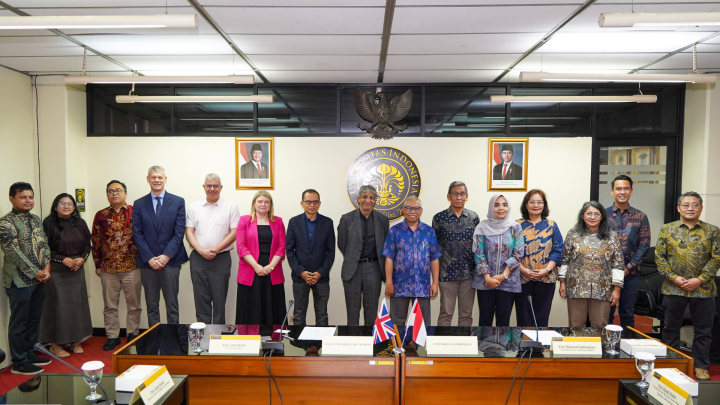
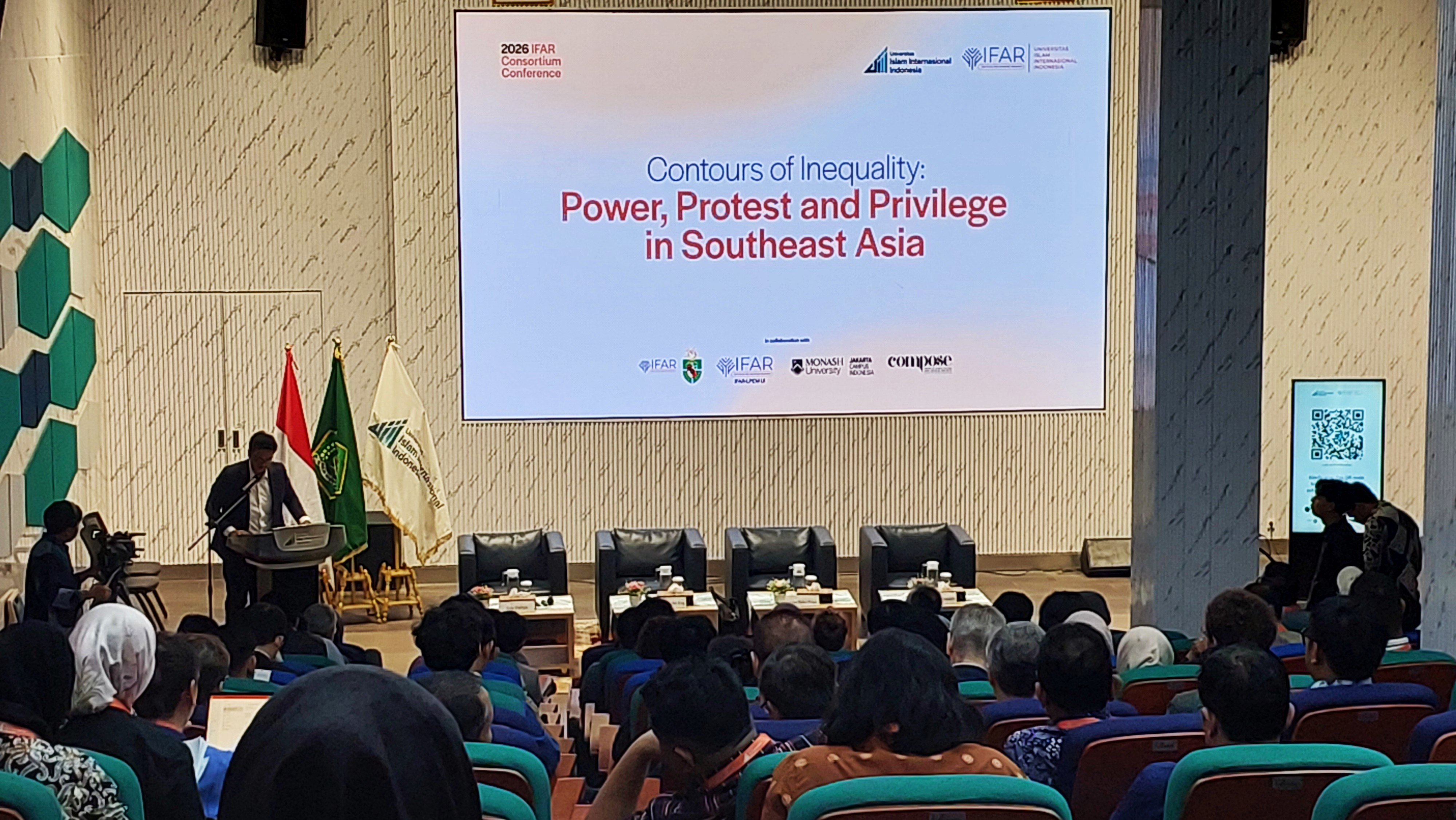
Depok, Indonesia — August 2026 — The 2026 IFAR Consortium Conference was successfully held at Universitas Islam Internasional Indonesia (UIII) from 12–14 August 2026, bringing together scholars, researchers, and students from various countries to examine one of Southeast Asia’s most enduring and complex challenges: inequality.
Organized by the Institute for Advanced Research (IFAR) at UIII, in collaboration with IFAR Monash University Indonesia, IFAR Unika Atma Jaya, IFAR LPEM UI, and the Center of Muslim Politics and World Society Studies (COMPOSE) at UIII, the three-day conference provided a platform for critical discussion on the causes, consequences, and changing forms of inequality across Southeast Asia.
Held under the theme “Contours of Inequality: Power, Protest, and Privilege in Southeast Asia,” the conference brought together perspectives from political science, economics, sociology, anthropology, public policy, environmental studies, and related fields. Its program explored inequality not simply as a question of income or wealth, but as a phenomenon closely connected to state-building, economic development, political power, identity, environmental change, technology, and social structures.
Exploring Inequality from Multiple Perspectives
The conference opened with a keynote address by Vivek Chibber, Professor of Sociology at New York University, on “What is Industrial Policy?” The keynote provided a broader perspective on the relationship between state intervention, economic development, and the distribution of resources—issues that are central to understanding inequality in developing economies.

The first plenary session, “Inequality in Indonesia,” brought the discussion closer to the Indonesian context. Umbu Reku Raya of Sumba Cendekia Bestari, Zulfan Tadjoeddin of School of Social Sciences, Western Sydney University, and Pierre van der Eng of the Australian National University examined different dimensions of inequality, including the structural drivers of inter- and intra-group inequality in Eastern Indonesia and the evolution of wealth inequality in Indonesia between 1990 and 2025.

The conference then expanded its focus to the broader Southeast Asian region. Sessions examined how climate change and resource politics intersect with inequality, including questions of climate justice, industrial development, land-use governance, and the social and environmental consequences of economic policies.
The program also addressed the political dimensions of inequality, including state power, identity, marginality, religion, ethnicity, and political institutions. These discussions underscored that inequality is not only about differences in economic outcomes, but also about who has access to power, opportunities, resources, and social protection.
A further strand of discussion examined the relationship between technology and inequality. Papers explored issues ranging from digital financialization and algorithmic governance to generative artificial intelligence, education, labor markets, and urban transportation. These discussions highlighted emerging forms of inequality associated with rapid technological change.
A Broad and Interdisciplinary Conference Program
Beyond the plenary sessions, the conference featured a wide range of parallel panels covering six broad areas: state-building, economic development, and inequality; economic policies, globalization, and inequality; state power, identity, marginality, and inequality; climate change and resource politics; technological development and artificial intelligence; and the consequences of political and economic inequality.

The breadth of presentations reflected the complexity of the conference theme. Discussions ranged from the political economy of carbon markets and Indonesia’s nickel down-streaming policy to gender and social reproduction, religious institutions and environmental justice, indigenous rights, refugees and borderlands, and the longer-term consequences of COVID-19 for employment, income, savings, and social inequality.
Importantly, the conference created space for both established scholars and emerging researchers to present their work, receive feedback, and engage in discussion with researchers working on related questions from different disciplinary and geographical perspectives.
This diversity was one of the conference’s key strengths. Rather than approaching inequality through a single analytical lens, the discussions demonstrated how different forms of inequality often overlap and reinforce one another. Economic inequality can be shaped by political institutions; environmental policies can produce uneven social consequences; technological transformation can create new forms of exclusion; and identities related to gender, ethnicity, religion, or geography can influence access to resources and opportunities.

The conference also provided opportunities for informal exchange and networking among participants. Such interactions are an important part of academic gatherings, allowing researchers to share ideas beyond individual sessions, identify common research interests, and build connections that may develop into future research collaborations.
Continuing the Conversation on Inequality
The discussions at the 2026 IFAR Consortium Conference reinforced that inequality in Southeast Asia is neither uniform nor static. Its forms and consequences vary across countries, communities, and historical contexts, while new economic, environmental, political, and technological developments continue to reshape its contours.
By bringing these different perspectives together, the conference provided a space not only to examine existing patterns of inequality, but also to question the policies, institutions, and power relations that produce and sustain them.
As the 2026 IFAR Consortium Conference concluded, its value ultimately lay in the conversations it generated—among disciplines, institutions, and generations of researchers. These conversations provide a foundation for further research and collaboration on inequality and related questions of development, governance, and social change in Indonesia and Southeast Asia.
The conference thus marks another step in strengthening opportunities for researchers working on Indonesia and the region to engage with one another and contribute to broader academic and policy debates.